
Research Coverage Map
We collected and mapped all the research.
Behind every number on this platform is a published field experiment — a real campaign, a randomized test, a measured outcome. We went through thousands and pulled together 196 high-quality scientific studies, catalogued every tactic, and analyzed what kind of election it ran in and what variables impacted its efficacy.
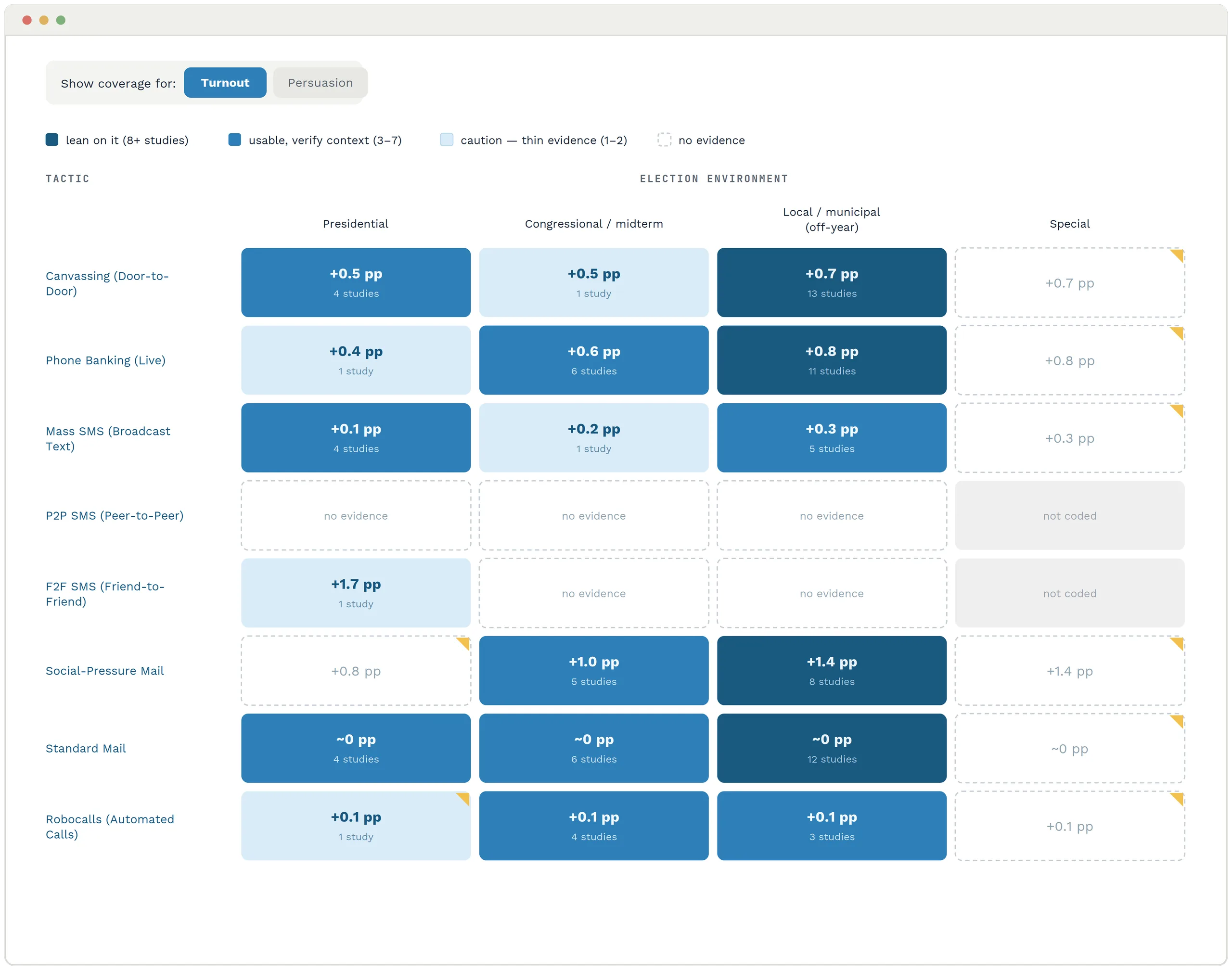
The same tactic doesn't behave the same way twice
A knock on the door means something different in a quiet school-board race than it does the week before a presidential election. When almost nothing else is competing for a voter's attention, personal contact — canvassing, phone calls, texting — tends to punch above its weight. Our data shows text messaging losing more than half its measured effect as a race goes from off-year to presidential, simply because the voter has a hundred other things pulling at them.
Broadcast and digital advertising run the opposite direction. Those tactics lean on ambient attention — voters already primed to be thinking about the race — which barely exists in a low-turnout special election and peaks in a presidential year. In our data, TV advertising's measured effect is over a third stronger in a presidential race than the baseline it was tested against. Same ad, different election, different result. A single "what works" number was always going to flatten that.
Where the evidence is thick, and where it just isn't
Turnout research is the deepest part of the literature — 41 tactic-by-environment combinations in our catalogue, 30 of them backed by direct measurement. Persuasion research is thinner: half as many combinations, and a real dropoff in how many are backed by a study at all, because far fewer experiments ever tested whether a tactic changes minds rather than just getting people to the polls.
Election type matters just as much. Presidential and off-year races carry the bulk of the research, because that's where most field experiments have historically been run. Special elections are nearly a blank page — not because tactics don't work there, but because almost nobody studies them. Where we can respectably project a measured effect into an untested environment, we do, and we say so. Where we can't, we leave it blank rather than dress up a guess as a finding.
That transparency is critical
Most sources will hand you a single confident number for "what works" and let you assume it holds everywhere. We'd rather show you the shape of what's actually known — where the research is deep enough to trust, where it's thin enough to be careful, and where it simply doesn't exist yet. That's not a weaker claim. It's the only one worth making.